


#GenerativeAI
The new SEO. The GEO Playbook for Creatives, Part 1 of 3
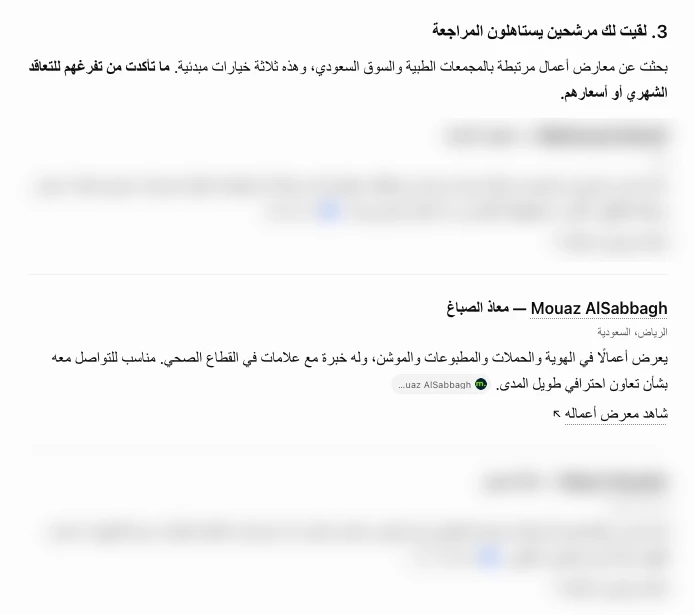
A stranger asked ChatGPT for a designer. It gave them three names. One was mine.
On Wednesday 11 November 2026, someone I have never met asked ChatGPT to help them find an all-round Arabic-speaking designer for a medical group in Saudi Arabia: social media, campaigns, brand identity, print and some motion, on a monthly basis.
ChatGPT explained where to look and which skills to ask for. Then, under the heading “I found you candidates worth reviewing”, it named three people. I was one of them.
Its description of me, translated from Arabic: based in Riyadh, shows work in identity, campaigns, print and motion, has experience with healthcare-sector brands, and is suitable to contact about long-term professional collaboration. It cited my site as the source and linked to my portfolio.
It is worth being exact, because this subject attracts exaggeration.
What it does show is narrower and more useful: when an AI assistant went looking for a designer with healthcare experience in Saudi Arabia, my portfolio was findable, readable, and specific enough to be summarised correctly in two sentences.
For over a decade, being found online meant search engine optimisation: keywords, backlinks and meta descriptions written for a ranking algorithm. The result was a list of ten links, and your job was to be near the top.
More and more, people skip the list. They describe what they need to an assistant and get back a short answer with a few names in it. There is no page two. You are either in the answer or you are not.
That changes the question a portfolio has to answer. A ranking algorithm asks “is this page relevant to these words?”. An assistant asks three things:
Look at what ChatGPT wrote about me. Every part of it maps to something stated plainly on the site: the city, the four disciplines, the healthcare clients. It did not praise the visuals. It could not see them. It repeated what it could read.
A portfolio made of beautiful images and one-line captions is, to a machine, almost empty.
That is the lesson of this series. Generative Engine Optimization (GEO) is the work of making your site easy to understand and safe to quote.
Part 2, Architecting for LLMs, covers the structured data and llms.txt behind the site, with the code. Part 3, Entity Clustering, shows how to write a case study so that a machine cannot misread it.
If you are a designer or art director, try this today: ask an assistant the question your ideal client would ask, in the language they would ask it. See who it names, and read what it says about them. Then read your own homepage and ask whether a machine could say the same about you.
Fusing macro-impact strategy, behavioral economics, and AI-accelerated craft to architect billion-scale growth for visionary entities.


Mouaz AlSabbagh
Senior Art Director and Creative Technologist in Riyadh. 12+ years turning institutional briefs into high-performance visual systems.